
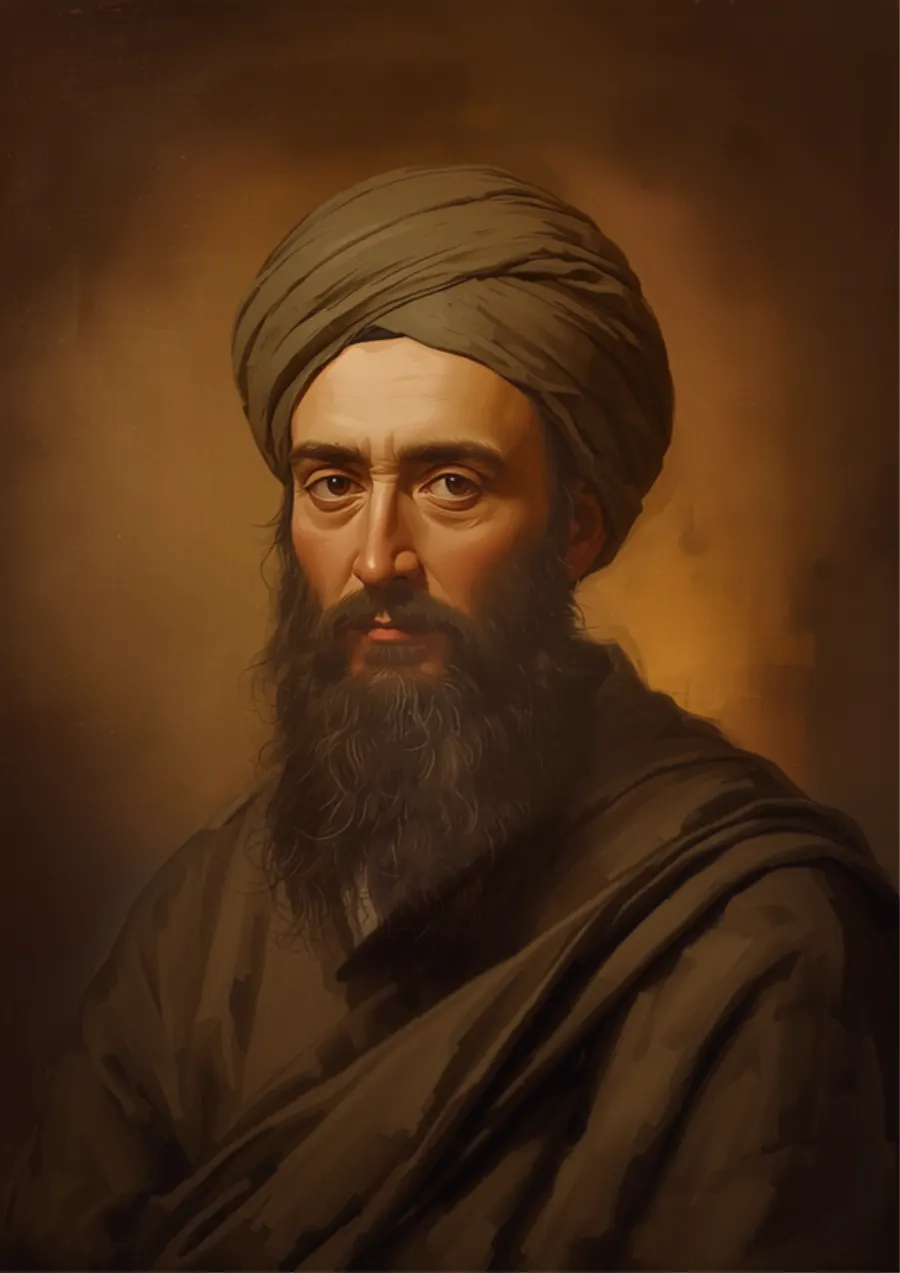
Rumi
1207 to 1273, Balkh to Konya
The reed's song. Longing as its own kind of arrival.
About Rumi
Jalal ad-Din Muhammad Balkhi, called Mowlana in Persian and Rumi in English, was born in Balkh in present-day Afghanistan and died in Konya in present-day Turkey. His family left Balkh ahead of the Mongol advance when he was a child.
He wrote two great works. The Masnavi-ye Ma’navi runs to six books of narrative and commentary. The Divan-e Shams-e Tabrizi is named for the wandering dervish whose arrival, and later disappearance, turned a respected jurist into a poet.
The name is a description of where he ended up. Konya sat in the territory Persian writers called Rum, the old Roman and Byzantine Anatolia, so Rumi means the one from Rum. Persians rarely use it. They say Molana or Molavi, meaning our master, and Turkish says Mevlana. One poet, four names, which is worth knowing if you are searching for him in more than one language.
The Masnavi is roughly twenty five thousand couplets and does not read like a collection of poems. It is a continuous argument carried by stories, one opening inside another, a merchant and a parrot giving way to a grammarian and a boatman. Persians have called it the Quran in Persian for centuries, meaning the scale of it rather than claiming any equivalence.
He did not found the order that carries his practice. The Mevlevi, the dervishes who turn, were organised after his death by his son and his followers, who built the ceremony around the sama, the listening he had already made part of his life. His funeral in Konya is described as having drawn Christians and Jews as well as Muslims, and his tomb there is still visited.
English readers mostly meet him twice removed. Reynold Nicholson edited and translated the whole Masnavi across eight volumes between 1925 and 1940, and that remains the scholarly text; his Selected Poems from the Divani Shamsi Tabriz of 1898 is the earlier and shorter door. Most of the Rumi circulating in English today descends instead from versions made without the Persian, which is why the same couplet can appear in two forms that share almost no words.
گرچه خزان کرد جفاها بسی
بین که بهاران چه وفا میکند
Though autumn committed many cruelties — see what faithfulness spring brings.