
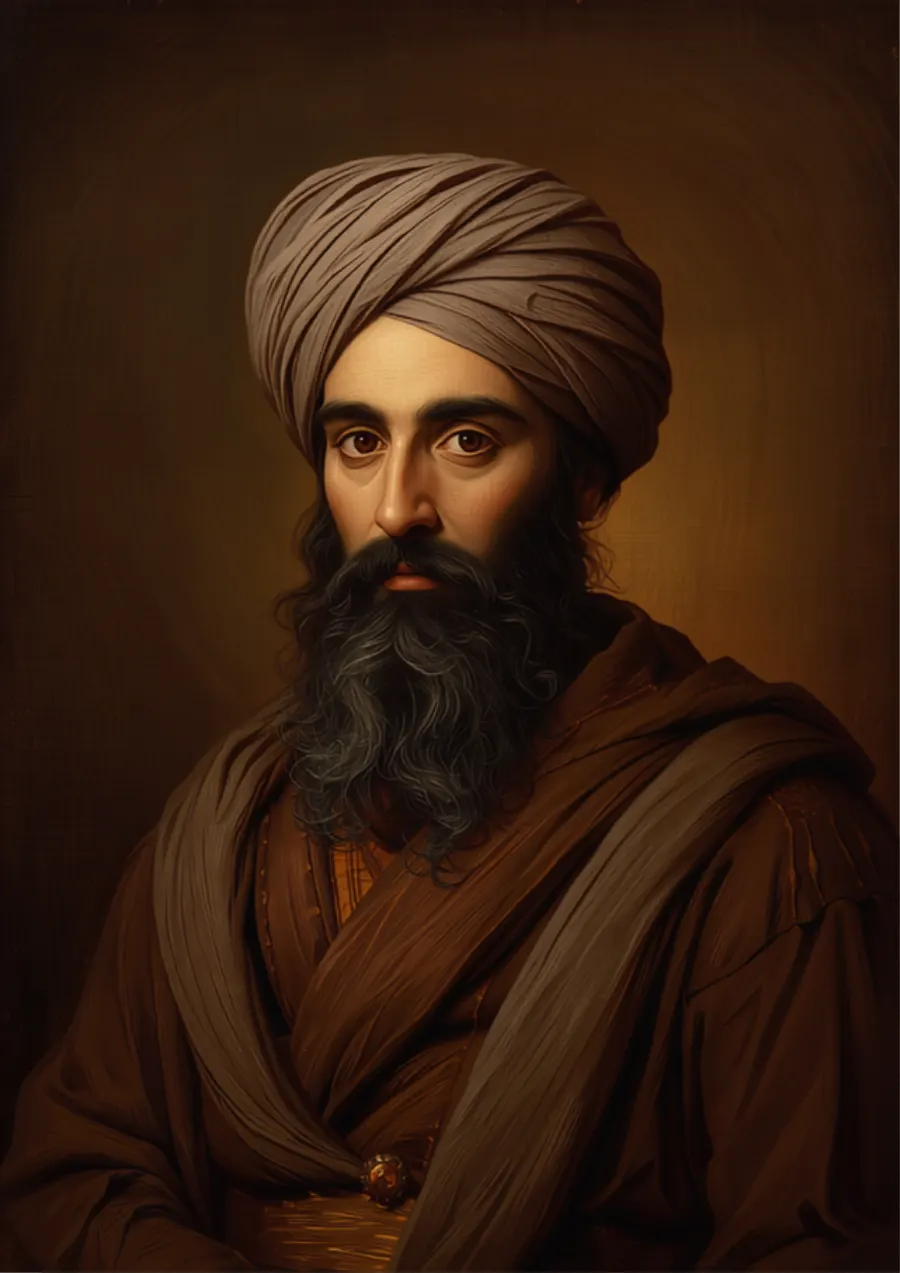
Khayyam
1048 to 1131, Nishapur
The rose and the wine cup. What is here is what there is.
About Khayyam
Ghiyath al-Din Abu’l-Fath Umar ibn Ibrahim Khayyam Nishapuri was, in his own lifetime and by his own reckoning, a mathematician and an astronomer. He wrote a treatise on cubic equations and helped reform the Persian calendar into the Jalali, which is more accurate than the Gregorian.
The quatrains came to English through Edward FitzGerald in 1859, in a version loose enough that scholars still argue about how much of it is Khayyam. The Persian originals are shorter, drier and harder.
The calendar was the day job and it was extraordinary work. Commissioned by the Seljuk sultan Malik Shah and completed around 1079, the Jalali reckoning sets the year by the moment of the spring equinox as observed, so Norooz falls on the first day of spring by measurement rather than by rule. A version of it is still the civil calendar of Iran and Afghanistan today.
The form he is remembered for is the rubai, a single quatrain rhyming on the first, second and fourth lines. It is a closed shape with room for one turn of thought, which suits an argument made and abandoned in four lines, and it is why his poems can be read in any order without loss.
Which quatrains are actually his is genuinely unsettled. Verses accumulated under his name for centuries after his death, and the manuscripts disagree; estimates of the authentic core run from a few dozen to several hundred. This is a real scholarly problem rather than a cautious hedge, and it is the reason a Khayyam collection in one edition may barely overlap another.
FitzGerald made him famous in English and also partly made him up, rearranging and combining until the sequence had an argument the Persian does not have. E. H. Whinfield published a closer, plainer rendering in 1883, and it is public domain. The app quotes the Persian and labels its English for exactly this reason.
چون عهده نمیشود کسی فردا را
حالی خوش دار این دلِ پر سودا را
مِی نوش به ماهتاب ای ماه که ماه
بسیار بتابد و نیابد ما را
Since none can guarantee tomorrow, keep this restless heart content today / Drink wine by moonlight — the moon will shine long after we are gone.