
Reading the whole poem, and hearing it read
A verse in Hamdam is a couplet lifted out of a longer poem. Tap it and you see the couplet with its themes and, where the verse carries them, the Persian symbols it is built from, each with a short reading from the app's own library.
Reading mode opens the whole poem it came from. Some of those poems can also be heard, read aloud by a person. Coverage is deliberately partial: a poem has a recording when a volunteer recorded it, and no recording is ever synthesised.
Verses reach readers who use Hamdam in Farsi, or who read in English and were born in Iran, Afghanistan or Tajikistan. Everyone else meets reflections in plain words instead.
Step by step
Tap the verse of the day on Today, or a favourite in Reflections. In the faal, use the book icon beside the verse to go straight to reading mode.
Read its themes, and the symbols underneath when the verse has any. Tap the heart to keep it in Favourites.
Themesمضامین
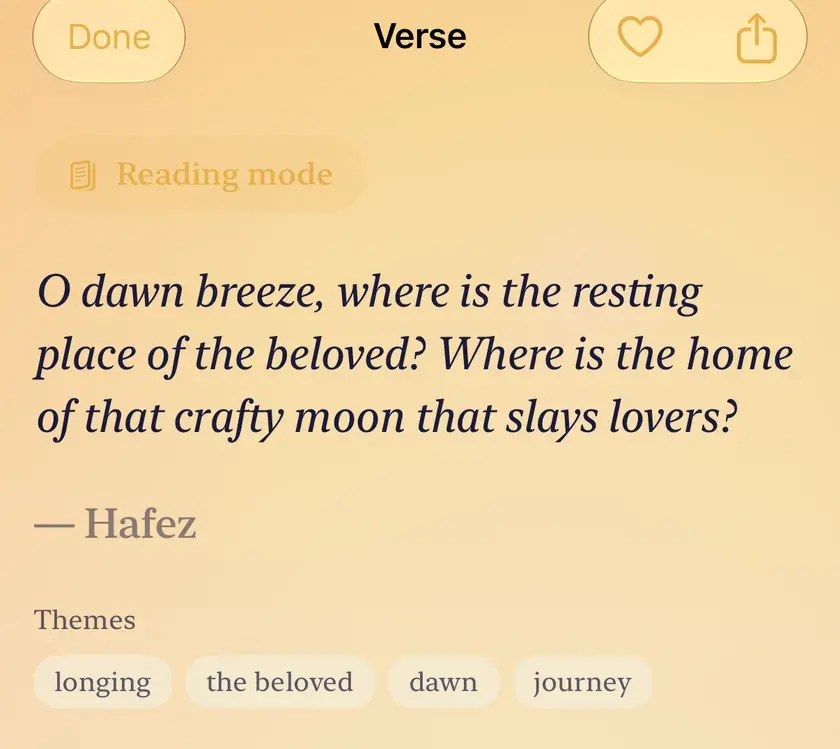
Open reading mode to see the whole poem rather than the couplet. The whole poems follow the recordings, so a verse nobody recorded opens on its couplet alone.
Reading modeحالت خواندن
In Farsi the poem appears in Persian. In English you see the couplet's translation first, then the poem it was taken from.
Where a recording exists and you read in Farsi, a play control sits at the top of reading mode, with the reciter and the source credited beside it.
Pinch to make the text larger or smaller, and swipe down to close.

Worth knowing
- Reading mode works for all seven poets, not just Hafez.
- 408 of the 700 verses can be heard, across 281 whole poems, with one named reciter per poet. So many verses can be heard, not every verse.
- Recordings play only in Farsi. A recording reads the whole Persian poem, and that is the version a Farsi reader is shown.
- The symbols and their readings come from the app's own sourced library. No language model writes about the poem.
- There is no synthetic speech anywhere in Hamdam. iOS ships no Persian voice, and a machine reading Hafez was not worth doing badly.