
The poets and the Persian symbols
Hafez and Rumi are free, and so is one symbol. The rest are Hamdam Plus.
Hamdam holds seven poets: Hafez, Rumi, Saadi, Khayyam, Parvin Etesami, Ferdowsi and Nezami. Their verses are public domain, gathered from the Ganjoor archive with attribution.
Alongside them sit six symbols that recur through the poetry: the rose, the nightingale, wine, the mirror, the candle and the nilofar.
Both sections appear when the country you were born in is Iran, Afghanistan or Tajikistan, or when you gave no birth country and read Hamdam in Farsi. Everybody else sees symbols from their own country instead, where Hamdam has a set for it.
Step by step
Open Roots and scroll past your family and the moments to the poets.
Rootsریشهها
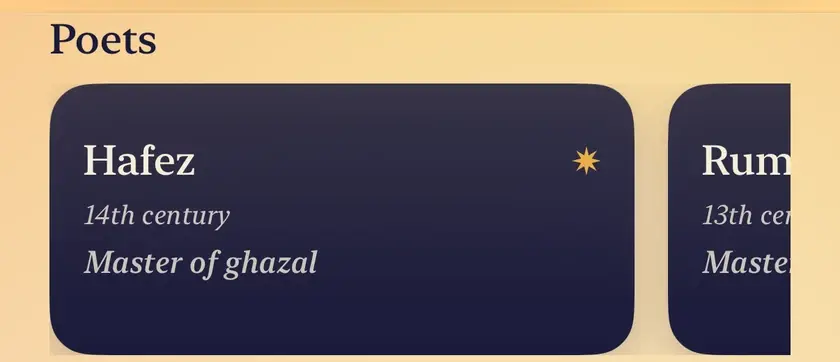
Tap a poet for their life and their work. A locked poet opens the Hamdam Plus screen instead.
Scroll on for the symbols, and tap one for what it has meant in the poetry. The candle has no passages written yet, so its card does not open.

Worth knowing
- The biographies come word for word from Wikipedia, in both languages, and are never rewritten or summarised by the app.
- On the free tier, Hafez and Rumi are open, and the rose is the open symbol. Hamdam Plus opens Saadi, Khayyam, Parvin, Ferdowsi and Nezami, and the other five symbols.
- If your roots are elsewhere, Roots shows a set of symbols from your own birth country in this place, with one of them open on the free tier. Sets exist for Australia, the United States, the United Kingdom, Canada, the Netherlands, Germany and the United Arab Emirates.
- Persian poetry uses wine, love and mystical imagery as literary and spiritual metaphor. Those are conventions of the form, centuries old, and not endorsements of anything.